


Blog

War, Algorithms, and Power: How Global Conflicts Are Reshaping the AI and IT Industry
Wed Mar 4 2026
Arpita Roy Biswas
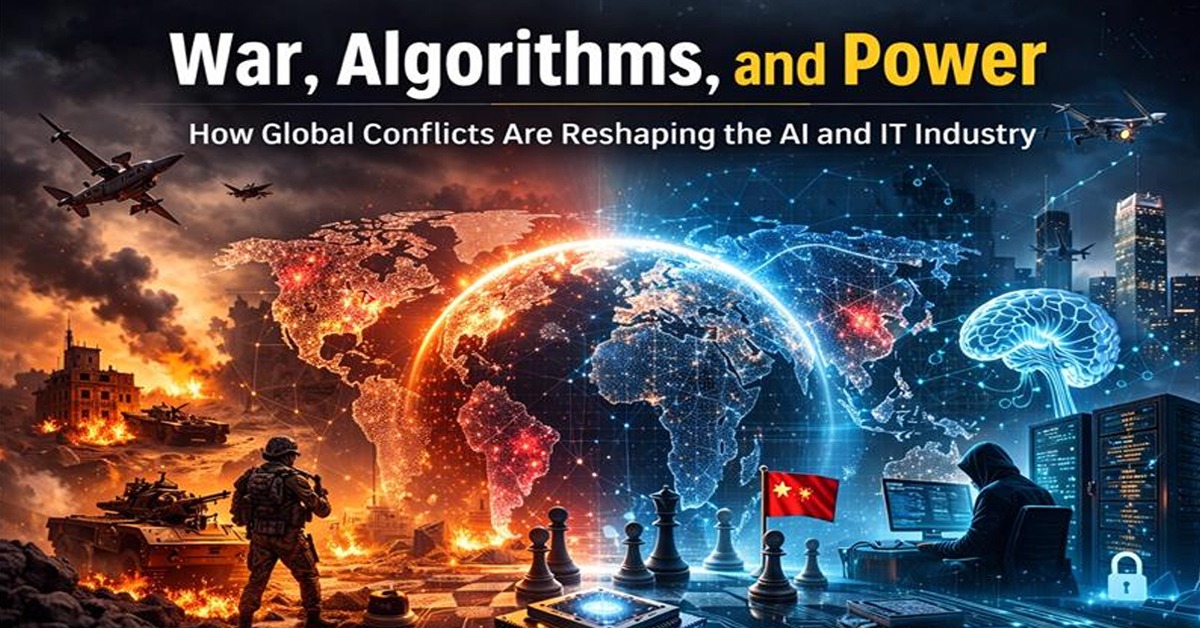
For decades, the technology sector evolved on a simple assumption: innovation would be driven by markets, talent, and ideas. Today that assumption is changing rapidly. The war impact on technology industry is becoming increasingly visible across artificial intelligence development, cyber security investments, and semiconductor manufacturing.
Wars are no longer limited to battlefields. They now extend into data centers, cloud infrastructure, semiconductor factories, and digital networks. Artificial intelligence has quietly become one of the most strategic technological assets nations possess.
This growing intersection of AI and geopolitics is reshaping how countries compete, collaborate, and secure technological advantage. As governments invest heavily in AI capabilities, understanding how war affects the AI industry has become increasingly important for policymakers, technology companies, and researchers alike.
The Emerging AI Arms Race
Artificial intelligence has long promised to transform industries, but governments now view it through the lens of national security. Countries around the world are investing heavily in military AI development, autonomous drones, and intelligence systems capable of processing enormous volumes of data.
Experts increasingly believe that AI in warfare will define the next generation of defense technology. From surveillance platforms to autonomous systems, AI is rapidly becoming central to military planning.
The role of AI in modern warfare continues to expand. Artificial intelligence is already used to analyze satellite imagery, predict potential threats, and support faster strategic decision-making during military operations.
This competition has created what analysts often describe as an AI arms race, where technological superiority may determine geopolitical influence in the decades ahead.
Cyber Warfare: The Invisible Battlefield
While traditional conflicts dominate headlines, a quieter battle is unfolding online. The importance of cybersecurity during conflict has grown dramatically as nations attempt to protect financial systems, communication networks, and critical infrastructure.
Artificial intelligence is playing a role on both sides of this digital battlefield. Security teams now deploy AI-driven tools to detect unusual network activity, identify threats, and prevent large-scale breaches.
At the same time, attackers are also leveraging artificial intelligence to automate hacking attempts and identify vulnerabilities faster than ever before.
This growing digital confrontation has transformed cyber warfare and AI into one of the most critical areas of modern defense strategy.
Semiconductor Supply Chains and Strategic Power
Behind every AI system lies a less visible but essential component: semiconductors.
Advanced chips power machine learning models, high-performance computing systems, and global cloud infrastructure. However, geopolitical tensions have placed enormous pressure on the global chip ecosystem.
Recent conflicts and trade restrictions have caused widespread semiconductor supply chain disruption, affecting AI infrastructure, hardware manufacturing, and global technology production.
As a result, governments are investing billions of dollars into domestic semiconductor manufacturing to reduce dependence on foreign suppliers and strengthen technological resilience.
In the digital economy, semiconductors are increasingly viewed as the strategic resource powering the next generation of innovation.
The Fragmentation of the Global Tech Ecosystem
For decades, the technology industry thrived on cross-border collaboration. Engineers, startups, and research institutions shared knowledge freely across global innovation hubs.
However, rising geopolitical tensions are gradually reshaping that model.
The geopolitical impact on technology is now visible across artificial intelligence research, semiconductor manufacturing, and global cloud infrastructure. Sanctions, export controls, and regulatory barriers are influencing where companies invest and where technology is developed.
This growing fragmentation could reshape how global innovation ecosystems function in the future.
The Rise of a Technology Cold War
Many analysts now believe the world is entering a new era often described as a technology cold war.
Major global powers are competing for dominance in artificial intelligence, semiconductor manufacturing, cybersecurity infrastructure, and emerging technologies such as quantum computing.
Control over these technologies is increasingly seen as a strategic advantage capable of influencing both economic strength and national security.
For companies operating in the global IT industry, this creates a new challenge: navigating innovation within an increasingly complex geopolitical environment.
The Future of Technology in a Geopolitical World
Despite rising tensions, technological innovation will continue to shape the global economy. Artificial intelligence is already transforming industries ranging from healthcare and climate science to logistics and automation.
However, the future of technology will increasingly be shaped by the intersection of AI and geopolitics.
As nations compete for technological leadership, the systems driving modern innovation—from AI models to semiconductor manufacturing—will play a defining role in global power dynamics.
In the digital age, power is no longer determined only by military strength. It is increasingly determined by algorithms, data, and technological infrastructure that quietly power the modern world.