



AI Chatbot Development Company: Complete Guide to Building Custom AI Chatbots in 2026
Thu, Oct 08, 2026
Arpita Roy Biswas
Businesses today are looking for faster ways to serve customers, manage repetitive tasks, and make information easier to access. AI chatbots have become a practical solution for these needs. Unlike traditional chatbots that rely on fixed questions and predefined responses, modern AI chatbots can understand natural language, process business information, and respond based on context.
An AI Chatbot Development Company helps businesses build these intelligent systems around their specific goals, data, workflows, and customer requirements. From website support and lead generation to internal knowledge management and customer service, custom AI chatbots can be designed for a wide range of business applications.
This guide explains what an AI chatbot development company does, the services it provides, how custom AI chatbots are built, the technologies involved, and the factors that influence development costs.
What Is an AI Chatbot Development Company?
An AI Chatbot Development Company designs and develops chatbot solutions that use artificial intelligence, machine learning, natural language processing, and large language models to communicate with users.
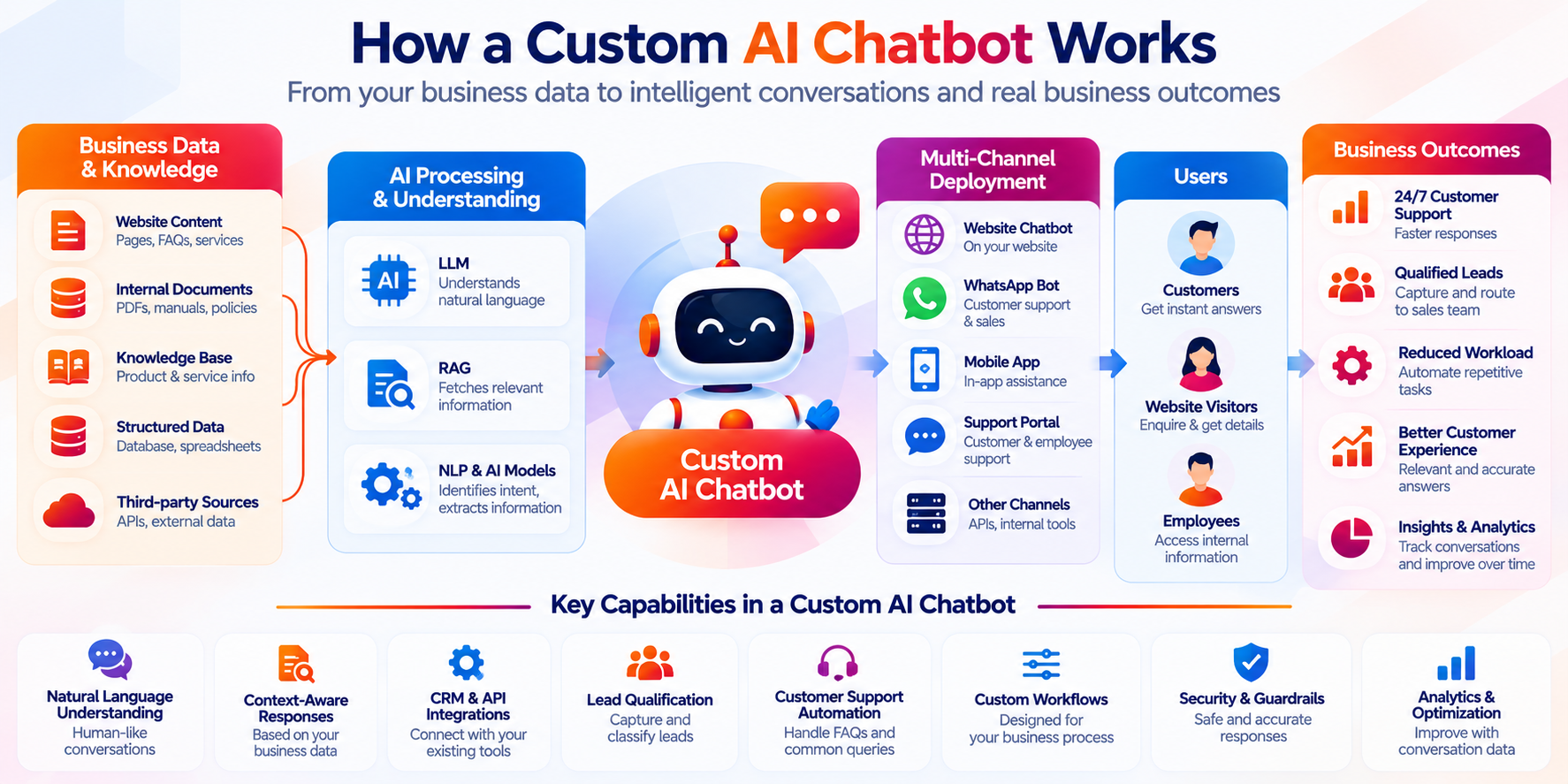
You can build a chatbot almost anywhere – on your website, inside a mobile app, through WhatsApp, your customer support portal, or even as part of your internal systems. But it’s not enough to just plug in a chat window. You want it to really understand what people are asking, pull up the right info, stick to your company’s rules, and actually help users out.
There’s a big difference between using an off-the-shelf chatbot and developing your own from scratch.
The ready-made ones come with a set of standard features you can tweak and set up for things like FAQs, capturing leads, or handling straightforward questions. They’re easy if your needs are pretty simple. But if you want the bot to do things your way, fit your unique workflows, handle your specific questions, basically reflect how your business really works – you need something custom.
Traditional rule-based chatbots are rigid. You click through a menu (“Admissions,” then “Course Fees”) and get a canned response. AI-driven chatbots step it up. They recognize different ways people might ask the same thing and reply in a natural, more human-sounding way.
A custom chatbot development company can build the system around specific workflows instead of limiting the business to the features available in an off-the-shelf platform.
For businesses looking to build such solutions locally, an AI chatbot development company in India can provide the technical expertise needed to design, develop, and deploy a chatbot around specific business requirements.
What Services Does an AI Chatbot Development Company Provide?
A professional AI chatbot development company can provide services covering the complete chatbot lifecycle, from planning and development to deployment and continuous improvement.
These chatbot development services can be tailored to customer-facing applications, internal business operations, sales support, or employee assistance.
AI chatbot development services can cover everything from initial consulting and custom development to integration, deployment, and ongoing optimization.
AI Chatbot Consulting
The process usually begins by identifying the business problem. A chatbot may be intended to reduce support workload, generate leads, answer employee questions, assist customers, or automate a particular process.
Businesses looking for AI chatbot development services in India can choose a development partner based on its experience with their industry, integrations, AI technologies, and business use cases.
Consulting helps determine where AI can provide genuine value and what type of chatbot architecture is appropriate.
Custom Chatbot Development
Custom chatbot development involves creating a solution specifically for the organization. The conversation flow, interface, business logic, knowledge sources, integrations, and workflows can all be designed according to the business requirement.
This approach is useful for businesses that need more than a basic FAQ bot.
For larger organizations, enterprise AI chatbot development can include advanced security, multiple integrations, role-based access, internal knowledge systems, and support for high volumes of conversations.
LLM Integration
Large Language Models, or LLMs- LLM chatbot development, allow chatbots to understand and generate natural language. Depending on the use case, developers can integrate an appropriate LLM and configure it to respond according to the company’s requirements.
LLM integration can make conversations more flexible while reducing the need to create hundreds of predefined responses.
A conversational AI development company focuses on creating more natural interactions, allowing users to communicate with the system using everyday language rather than fixed commands.
RAG Chatbot Development
RAG, or Retrieval-Augmented Generation, – RAG chatbot development is particularly useful when businesses want an AI assistant to answer questions using their own documents and knowledge sources rather than relying only on general model knowledge.
This is useful when the chatbot needs to answer questions using company documents, product information, policies, manuals, FAQs, or other business-specific content.
Knowledge-Base Integration
Businesses often have information spread across documents, websites, databases, and internal systems. Knowledge-base integration allows the chatbot to access relevant information and provide users with more context-specific responses.
CRM and API Integration
Chatbots can be connected to CRM platforms, ERP systems, payment systems, databases, ticketing platforms, and other business applications through APIs.
For example, a chatbot could collect a customer’s requirements, check information from a CRM, and pass the conversation to a sales team when human assistance is required.
WhatsApp Chatbot Development
WhatsApp is widely used for customer communication. A WhatsApp chatbot can handle enquiries, share information, qualify leads, send updates, and support customer interactions through a familiar communication channel.
Website Chatbot Development
A website chatbot can provide instant assistance to visitors without requiring them to search through multiple pages. It can answer questions about services, pricing, products, processes, or contact information.
Website chatbots can also support lead generation by collecting visitor details and identifying potential prospects.
Lead Qualification
AI chatbots can ask visitors relevant questions and identify their requirements before passing qualified leads to the sales team.
This can help sales representatives spend more time on high-intent prospects instead of manually handling every initial enquiry.
Analytics and Optimization
Launching a chatbot is not the final step. Businesses can analyze conversations to understand frequently asked questions, unsuccessful responses, user behavior, and areas where the chatbot needs improvement.
Continuous optimization can help improve response quality and the overall customer experience.
How Does AI Chatbot Development Work?
The development process depends on the business use case, but a typical project follows a structured process.
1. Business Goals
The first step is defining what the chatbot needs to achieve. The goal could be customer support, lead generation, employee assistance, sales support, or process automation.
2. Data and Knowledge
Next, developers identify the information the chatbot needs to use. This may include website content, FAQs, product catalogues, company documents, policies, or structured business data.
3. Conversation Design
The next stage focuses on how users will interact with the chatbot. Common questions, conversation flows, fallback responses, escalation rules, and human handoff processes are defined.
4. AI/LLM Integration
The appropriate AI or LLM technology is selected and integrated. The system may also use retrieval mechanisms so that responses can be generated using business-specific information.
5. Development
Developers build the chatbot interface, backend systems, integrations, workflows, authentication, data connections, and other required components.
AI chatbot developers also work on the underlying integrations, business logic, APIs, authentication, and data connections that make the chatbot functional beyond the conversation interface.
6. Testing
The chatbot is tested against different types of questions and scenarios. Testing helps identify incorrect responses, broken conversation flows, integration issues, and security concerns.
7. Deployment
Once the chatbot meets the required standards, it can be deployed on the selected channels, such as a website, mobile application, or WhatsApp.
8. Optimization
After deployment, real user interactions provide valuable information. The chatbot can then be updated based on user behavior, new business information, unanswered questions, and performance data.
What Technologies Are Used to Build AI Chatbots?
Modern AI chatbot development can involve several technologies depending on the project requirements.
Large Language Models
LLMs provide the language understanding and generation capabilities behind modern conversational AI systems. The selected model depends on factors such as accuracy, cost, response speed, privacy, and the complexity of the use case.
Natural Language Processing
Natural Language Processing, or NLP, enables systems to understand human language. It helps identify user intent, interpret questions, and process different ways of expressing the same requirement.
RAG
RAG enables a chatbot to retrieve relevant information from an external knowledge source before generating a response. This is particularly useful for business-specific information.
Vector Databases
Vector databases can store information as numerical representations called embeddings. They allow the system to find content that is semantically related to a user’s question.
APIs
APIs allow the chatbot to communicate with external applications and business systems. This makes it possible to retrieve information or trigger actions during a conversation.
CRM Integrations
CRM integration can connect chatbot conversations with customer records, lead information, sales processes, and support activities.
Cloud Platforms
Cloud platforms provide infrastructure for hosting chatbot applications, APIs, databases, AI services, and other components required by the solution.
Analytics
Analytics tools help businesses understand chatbot usage, conversation patterns, response performance, and user engagement.
Security and Guardrails
Security needs to be considered throughout the development process. Access controls, data protection, authentication, monitoring, and AI guardrails can help control how the chatbot accesses and processes information.
At Pixel Solutionz, these technologies can be combined according to the specific business requirement rather than following a single architecture for every chatbot project.
How Much Does AI Chatbot Development Cost?
The cost of building an AI chatbot varies significantly because every project can have different requirements. There is no single fixed AI chatbot development price that applies to every business.
Several factors influence the AI chatbot development cost in India.
Chatbot Complexity
A basic FAQ chatbot requires less development than an AI assistant capable of handling complex conversations and business workflows.
Number of Integrations
Integrating a chatbot with CRM, ERP, payment systems, databases, ticketing software, or other platforms can increase development effort.
Knowledge Base
The amount and type of information the chatbot needs to process can affect the architecture and development requirements.
LLM and API Usage
AI models and external APIs may involve usage-based costs. Higher conversation volumes can increase ongoing operational expenses.
Number of Channels
A chatbot deployed only on a website will generally require a different setup from one deployed across websites, WhatsApp, mobile applications, and other channels.
Custom Workflows
If the chatbot needs to perform actions such as creating support tickets, qualifying leads, checking application status, or retrieving customer records, additional development may be required.
Security Requirements
Businesses handling sensitive or confidential information may require additional authentication, access control, monitoring, and security measures.
Analytics
Advanced reporting and conversation analytics can add to the development scope.
Ongoing Maintenance
AI chatbot systems require regular updates. Business information changes, APIs are updated, models evolve, and new user questions appear over time. Maintenance helps keep the chatbot useful after launch.
Therefore, the custom AI chatbot development cost depends on the project’s scope rather than simply the chatbot interface itself. Businesses should evaluate the expected use case, integrations, AI requirements, and long-term operational needs before deciding on a development budget.
Conclusion
AI chatbots have moved beyond simple automated responses. With LLMs, RAG, APIs, knowledge bases, and business integrations, companies can build conversational systems that support customers and employees while automating repetitive activities.
The right AI chatbot solutions can help businesses automate repetitive interactions while making information more accessible to customers and employees.
Working with an AI Chatbot Development Company can help businesses move from a basic chatbot concept to a solution designed around their actual processes. The right approach depends on the business objective, available data, required integrations, communication channels, security requirements, and expected scale.
For businesses considering a custom chatbot, the first step is to clearly define the problem the chatbot needs to solve. Once that is established, the technology, architecture, development approach, and budget become much easier to determine.
Contact Us
FAQs
What does an AI chatbot development company do?
An AI chatbot development company designs and builds AI-powered conversational systems for businesses. It can handle chatbot consulting, custom development, LLM integration, knowledge-base integration, CRM/API connections, deployment, testing, and ongoing optimization.
How much does AI chatbot development cost?
The cost depends on chatbot complexity, integrations, knowledge-base requirements, AI model usage, number of channels, custom workflows, security requirements, and ongoing maintenance. Therefore, AI chatbot development cost in India can vary considerably from one project to another.
How long does it take to develop an AI chatbot?
Development time depends on the scope of the project. A simple chatbot with limited functionality can be developed faster, while a custom solution involving RAG, multiple integrations, business workflows, and several communication channels requires more development and testing time.
What technologies are used for AI chatbot development?
AI chatbots can use LLMs, NLP, RAG, vector databases, APIs, CRM integrations, cloud platforms, analytics tools, and security controls. The technology stack is selected according to the chatbot’s business requirements.
Can an AI chatbot connect to a CRM?
Yes. AI chatbots can connect with CRM systems through APIs or available integrations. This can allow the chatbot to capture leads, retrieve customer information, update records, qualify prospects, or transfer relevant conversations to sales and support teams.
